May 18, 2026 • Marlowe Finch • 8 min reading time • Prices verified June 4, 2026
From $20 to $200: Which Portable Charcoal Grill Actually Earns Its Price Tag
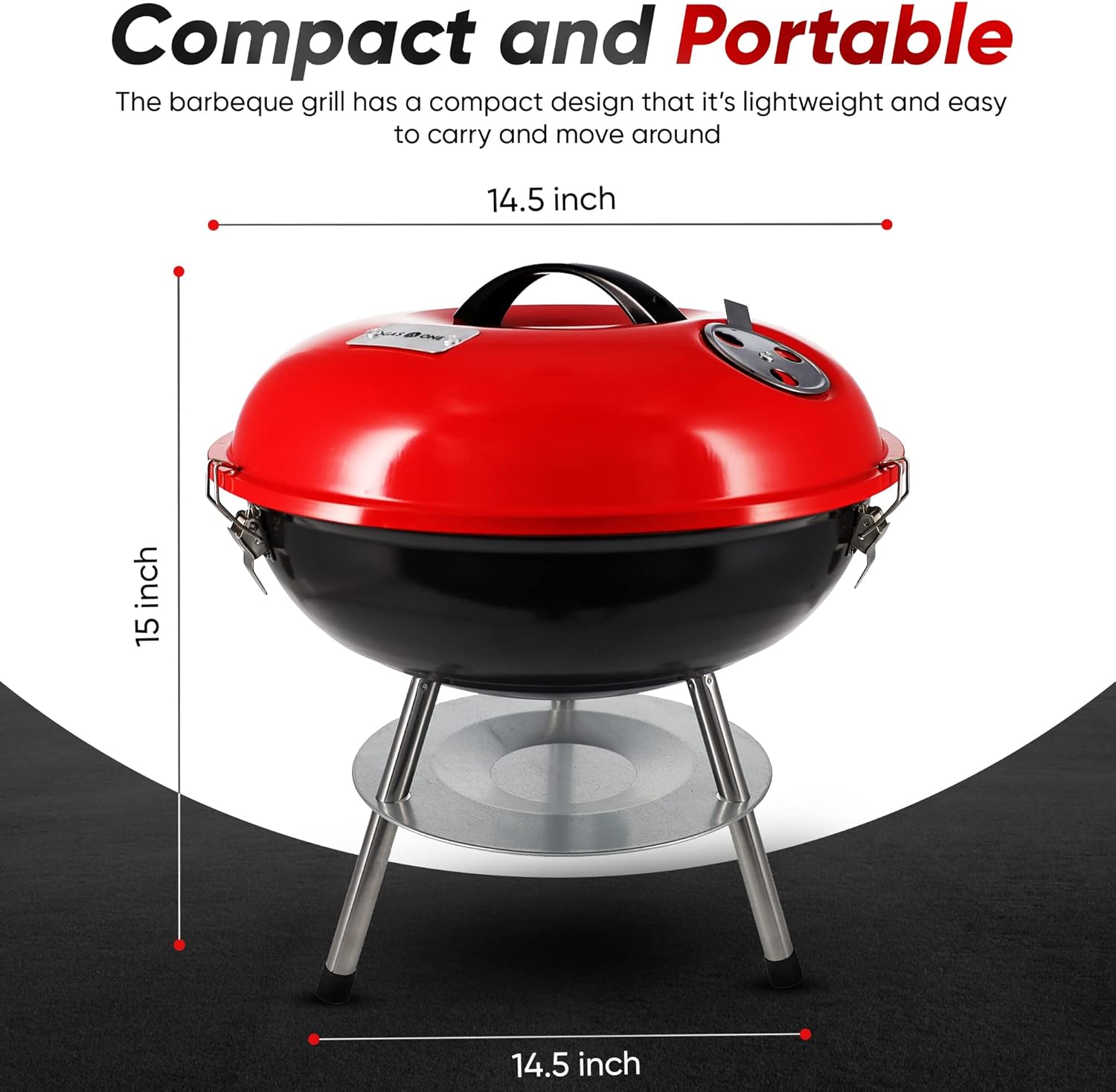
A portable charcoal grill is exactly what it sounds like: a charcoal-burning grill (one that uses burning coals rather than gas or electricity as its heat source) built small enough to carry to a campsite, a tailgate, a rooftop, or a balcony. The charcoal format is beloved by serious outdoor cooks because burning charcoal delivers a high, dry heat and a subtle smoky flavor that gas can’t fully replicate — but it also demands more setup and airflow management than just turning a dial. Within this category, you can spend as little as $20 on a bare-metal hibachi (a shallow, open-topped charcoal tray — the simplest grill form there is) or push past $200 on a precision-engineered compact kettle with a tight-sealing lid and adjustable vents. This guide maps that entire range, names the tradeoffs at each price tier, and ends with a clear decision rule so you can stop browsing and start cooking.
| EDITOR'S PICK[Oklahoma Joe's Rambler Portable](https://www.amazon.com/dp/B096LMWM59?tag=greenflower20-20)… | Mid-tier[Weber Jumbo Joe Charcoal Grill](https://www.amazon.com/dp/B0098HR0RC?tag=greenflower20-20) | Budget pick[Cuisinart 14" Portable Charcoal](https://www.amazon.com/dp/B00B58A0QU?tag=greenflower20-20)… | |
|---|---|---|---|
| Cooking Area | 218 sq. in. | — | — |
| Diameter | — | 18 in. | 14 in. |
| Material | — | — | Chrome Plated |
| Locking Lid | — | ✓ | ✓ |
| Portable | — | ✓ | ✓ |
| Price | $199.00 | $89.99 | $37.39 |
| See on Amazon → | See on Amazon → | See on Amazon → |
What You’re Actually Buying at Each Price Point
The $20–$50 tier is almost entirely hibachi-style and disposable grills — open trays with a fixed grate, minimal airflow control, and metal so thin it warps after a season. These aren’t bad for what they are; they’re honest tools. A Lodge cast-iron hibachi (street price around $35–$45) is the category’s standout exception: the cast iron retains heat well, the grate sits at a fixed height, and owners consistently report using the same unit for years without rust problems when dried after each use. For occasional beach trips or car camping where pack weight isn’t the deciding factor, it earns its shelf space. But for everyone else, the limitations are real: no lid means no indirect cooking (the technique of placing food away from the coals to cook it slowly via ambient heat rather than direct flame), no temperature regulation, and no protection from wind, which can cut your effective cooking temperature by 30–50% in open terrain — a point Outside Online’s 2025 portable grill roundup flags as the most underrated failure mode for entry-level charcoal units.
The $50–$120 range is where it gets genuinely interesting and genuinely messy. This is the zone of compact kettle grills — round, lidded grills modeled on the classic Weber shape but scaled down to roughly 14–18 inches of cooking diameter. The lid is the key upgrade: it traps heat, enables indirect cooking, and cuts wind interference. Vent control (adjustable holes in the lid and the bowl that regulate airflow and therefore temperature) arrives in this tier, and it changes the cooking fundamentally. You can now smoke a whole chicken or reverse-sear (a method of cooking thick meat low and slow first, then finishing over high direct heat for a crust) a thick ribeye — techniques that are simply unavailable on an open hibachi. The tradeoffs here are build quality and longevity. Across aggregated reviews, the pattern is consistent: sub-$80 kettle knockoffs use gauge steel thin enough to dent by hand, and grate coatings that chip within a few cooks, leaving bare steel that rusts and potentially contaminates food.
The $120–$200 band is where manufacturer engineering investment starts showing up in ways that matter to a serious cook. Weber’s Smokey Joe (14.5-inch cooking area, street price approximately $45–$55 depending on retailer) sits at the lower edge of the kettle category and is the benchmark everyone else gets measured against — Wirecutter’s charcoal grill coverage consistently points to it as the reference-class compact kettle for value. At the upper end, the Weber Jumbo Joe (18-inch) and the PK Grill Go (a rectangular cast-aluminum unit at roughly $175–$190) represent meaningfully different constructions. Cast aluminum — a metal alloy formed by pouring molten aluminum into a mold — doesn’t rust, distributes heat more evenly than thin steel, and is lighter than cast iron. PK Grill owners in long-run reviews note that units purchased in the early 2010s are still in active use with no structural degradation; that’s a five-year-plus total-cost story that a $40 knockoff simply cannot tell.
The Numbers That Actually Predict Performance
Before naming picks, here’s the honest comparison math:
By the numbers — what separates a $45 unit from a $175 one:
| Factor | Sub-$80 kettle | Weber Smokey Joe ($50) | PK Go (~$180) |
|---|---|---|---|
| Cooking area | 150–200 sq in | 147 sq in | 170 sq in |
| Lid seal quality | Poor–fair | Good | Excellent |
| Material gauge | Thin steel | Medium steel | Cast aluminum |
| Vent adjustability | Fixed or 1-position | 2-position | 4-position |
| Estimated useful life | 1–3 seasons | 5–8 seasons | 10–15+ seasons |
Cooking area (measured in square inches of grate surface) matters less than marketing suggests. The real predictors of sear quality are BTU-per-square-inch — the amount of heat energy delivered per unit of cooking surface — and how well the lid seals. A leaky lid bleeds heat and lets wind disrupt the thermal environment inside the grill; AmazingRibs.com’s portable charcoal grill analysis specifically flags lid-seal quality as the engineering variable most budget units sacrifice first.
The Hidden Costs Most Buyers Miss
At this tier of buyer, you already know the sticker price isn’t the whole number. Here’s where the math diverges between price tiers over a realistic ownership window.
Charcoal consumption is roughly equivalent across the category — charcoal is charcoal, and a 14-inch kettle doesn’t burn significantly more than a hibachi for a similar cook. Where cost diverges is replacement parts and longevity. A sub-$60 knockoff kettle that fails after two seasons has an effective annual cost of $25–$30. The Weber Smokey Joe, spec-rated to last years longer, drops that annual number significantly — and replacement grates, ash catchers, and vent hardware are still in production and widely stocked, a point Serious Eats’ 2025 portable grill coverage highlights as a genuine differentiator for Weber versus generic competitors.
Accessories are where the $50–$120 tier quietly bleeds money. An entry-level compact kettle with no thermometer mount, no ash catcher, and no tool hooks pushes you toward purchasing those separately — or cooking without them, which degrades results. The PK Go and upper-tier Webers arrive configured for real cooking without a peripheral shopping list.
Total 5-year cost estimate (rough math, mid-2026 pricing):
- $40 knockoff kettle × 2 replacements + accessories: approximately $140–$180
- Weber Smokey Joe + accessories: approximately $110–$130
- PK Grill Go (no accessories needed): approximately $175–$190
The knockoff isn’t cheaper over time. That’s the decision-frame that buyers who’ve owned two or three entry-level grills eventually reach on their own; the math just gets there faster.
Wind, Weight, and the Campsite Reality
Here’s what the spec sheet won’t tell you, but owner reports make clear: a compact kettle with a good lid seal at 6,000 feet of altitude (where air is thinner and oxygen for combustion is reduced) outperforms an open hibachi on a calm day at sea level for sustained cooking temperatures. Outside Online’s 2025 portable grill roundup notes that altitude and wind are the two variables that most dramatically separate adequate portables from genuinely reliable ones — and both are problems that a tight lid solves in ways that no amount of extra charcoal can compensate for in an open tray.
Weight is the legitimate counter-argument for backpacking scenarios. A cast-aluminum PK Go weighs approximately 14 pounds; a Lodge hibachi runs 7–10 pounds; a folding steel hibachi can come in under 4 pounds. If you’re carrying a grill on a trail rather than loading it into a vehicle, the calculus shifts sharply. For car camping, tailgates, rooftop setups, or van cooking, the weight difference between a $45 hibachi and a $175 PK Go is irrelevant. For actual hike-in trips, it isn’t — and no amount of build quality justifies a grill that stays in the truck because it’s too heavy to carry.
If you’re a balcony cook: check your building’s fire code before any charcoal purchase. Many urban multi-family buildings in U.S. cities prohibit open-flame charcoal grills on balconies; some specify a minimum clearance from the building structure. Apartment Therapy’s coverage of urban grill restrictions (2024–2025) documents the patchwork of local regulations and notes that enforcement has increased as urban density rises. A $175 cast-aluminum grill on a balcony where charcoal is prohibited isn’t a bargain at any price.
The Decision Rule
Here’s the framework, stated plainly:
If your primary use is occasional beach trips, festival cooking, or anywhere you’d accept a single-use disposable: a Lodge hibachi at $35–$45 is the honest choice. It does the job, it lasts, and it doesn’t cost more than the experience it supports.
If you cook outdoors more than four or five times a season and want real temperature control: the Weber Smokey Joe is the default right answer. The lid seals properly, the vents work, replacement parts are available indefinitely, and the total cost over five years is lower than two rounds of cheap alternatives. Serious Eats consistently positions it as the value benchmark in this category, and the aggregated owner record backs that up.
If you’re cooking for four or more people regularly, doing overnight smokes, or treating your portable setup as a primary cooking rig rather than a backup: the 18-inch Weber Jumbo Joe ($80) or PK Grill Go ($175–$190) is worth the step-up. The PK Go’s cast-aluminum construction and four-position vent system give you genuine smoking capability — the ability to hold 225–275°F for hours — that the Smokey Joe’s smaller firebox and single lower vent can only approximate.
If weight is the actual constraint (backpacking, bicycle touring, ultralight camping): a folding steel hibachi under $40 is the only honest recommendation. Accept the cooking limitations; the alternative is a grill that doesn’t make the trip.
The $20–$200 charcoal portable range is wide enough to contain genuinely different tools, not just the same tool at different price points. The mistake most buyers make is optimizing for the sticker price on a tool they’ll use for years. Run the five-year number instead — and buy accordingly.